GST Basics Guide: register, file and stay compliant
GST Basics Guide is our starting hub for Goods and Services Tax in New Zealand. It covers the first decisions every sole trader, contractor and small company faces: when you must register, how often you file, which accounting basis to pick, and how to avoid the mistakes that trigger Inland Revenue (IRD) letters.
This page is for the 2026/27 tax year (1 April 2026 to 31 March 2027). The posts listed below go deeper on each step. Use this intro as the map, then open the guide that matches where you are in the cycle.
How GST works in plain English
On IRD’s GST overview, GST is a tax added to the price of most goods and services, including many imports. The standard rate is 15% (in force since 1 October 2010). When you are registered you collect GST from customers, claim GST on costs that relate to your taxable activity, and pay the difference (or claim a refund) when you file.
Business.govt.nz puts the same idea in small business language: keep invoices and receipts, set GST money aside, and file on time. Day to day add or remove maths belong on the free GST calculator. IRD’s worked exclusive and inclusive examples sit on calculating your GST and in GST guide IR375.
For a wider system overview across every GSTCalc.nz category, start with the GST Guide NZ category or the ultimate guide to GST in New Zealand. This Basics Guide stays on the registration and filing path.
When you must register: the $60,000 threshold
IRD’s registering for GST page says you must register if you carry on a taxable activity and either of these applies: your turnover was at least $60,000 in the last 12 months, or you expect it will be at least $60,000 in the next 12 months; or you add GST to the prices of the goods or services you sell.
That $60,000 figure is a rolling 12 months of taxable supplies. It is not limited to a 1 April to 31 March year. Under the Goods and Services Tax Act 1985 you apply within 21 days of becoming liable. Unpack the rolling test in our $60,000 GST threshold guide. If you trade under more than one brand as the same legal person, turnover still adds up under one registration: see multiple trading names.
Voluntary registration under $60,000
You can still register if turnover is under $60,000. IRD’s voluntary registration page lists the usual upsides: you can claim GST on taxable activity costs, and dealing with GST registered suppliers can be cleaner. The downsides are real: you must add GST to prices, file returns on time, and late filing or late payment attracts penalties.
Voluntary registration often helps if your customers are other GST registered businesses. It often does not help if you sell mainly to the public and cannot lift prices by 15%. Work through that choice in should I register for GST voluntarily. New operators can follow the new business GST compliance roadmap.
How to register in myIR
You register in myIR. IRD asks for your IRD number, a bank account for refunds, turnover for the last 12 months and expected turnover for the next 12 months, plus a BIC (business industry classification) code. IRD says it usually processes applications within 10 working days. Your GST number is the same as your IRD number.
Once registered you must charge GST, file every return (including nil returns), pay what you owe, and keep records. IRD’s record keeping guidance says keep records for at least seven tax years. Step by step screenshots and choices: how to register for GST in NZ.
Filing frequency: monthly, two monthly or six monthly
You choose filing frequency when you register. IRD’s accounting basis and filing frequency table (any 12 month period) is:
- Six monthly: available if sales are under $500,000. Two returns a year. Suitable when transaction volume is low.
- Two monthly: available if sales are under $24 million. IRD’s practical default for many new registrations if you do not choose carefully.
- Monthly: available to anyone. Compulsory if sales are over $24 million. Useful if you regularly get refunds.
For a 31 March balance date, two monthly periods usually end in odd months (May, July, September, November, January, March). Six monthly periods usually end 30 September and 31 March. Confirm your dates in myIR. A filing walkthrough is in how to file your GST return in myIR, and a date list sits on the GST tax due date calendar.
Accounting basis: invoice, payments or hybrid
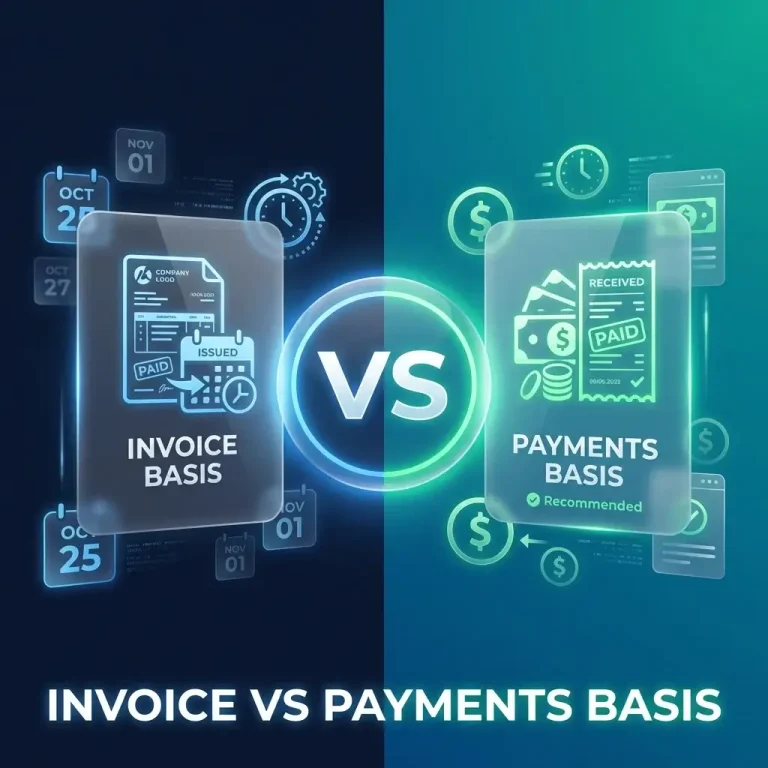
Accounting basis decides when GST goes on the return, not the 15% maths. If you do not choose, IRD defaults you to the invoice basis.
- Invoice basis: available to anyone. You generally return GST when you invoice a customer, and claim when a supplier invoices you (if you hold taxable supply information).
- Payments basis: available if sales are $2 million or less (and likely to stay under that). You return GST when customers pay you, and claim when you pay suppliers. Business.govt.nz notes this is the most common choice for small business.
- Hybrid: available to anyone, but uncommon for small firms. Invoice basis for sales, payments basis for expenses, which can create cashflow pressure.
A contractor who invoices late but pays suppliers in cash often prefers payments basis. Compare the options in invoice basis vs payments basis. Retail cash sales versus project invoices are worked through in retail vs contractor GST.
Taxable supply information on invoices
From 1 April 2023 IRD talks about taxable supply information rather than only the old “tax invoice” label. You can still title a PDF “Tax Invoice”. What you must show depends on the value of the supply (including GST): under $200 the buyer often does not need a full document from you, but both sides still keep records; more than $200 up to $1,000 needs seller details, GST number, description, and GST amount or a clear “GST included” statement; over $1,000 also needs information that identifies the buyer.
Build a compliant document with the GST invoice generator. Contractors who also have tax withheld from pay should pair that with the withholding tax calculator, and sole traders estimating year end tax can use the self employed tax calculator.
Zero rated versus exempt supplies
Both mean you do not charge 15% on the sale. The difference is what you can claim. IRD sets this out under zero rated supplies and exempt supplies.
Zero rated (0%). Still a taxable supply. You can usually claim GST on related costs. Common examples include exported goods and many exported services (conditions apply).
Exempt. Outside GST. You cannot claim GST on costs of making that supply. IRD examples include residential rent and most financial services. The split is explained in exempt vs zero rated supplies. Fines and penalties are a separate trap: you usually cannot treat them like ordinary business purchases. See GST on fines and penalties.
Due dates, late filing and interest
Once registered you must file a GST return for every taxable period, including a nil return. IRD’s filing and paying GST page says you cannot get extra time to file.
The due date is usually the 28th of the month after the period ends. Two exceptions from IRD: period ending 30 November is due 15 January, and period ending 31 March is due 7 May. If that day is a weekend or public holiday, the next working day applies.
Provisional tax can fall on some of the same days. Use the provisional tax calculator for instalments, and read how the two systems interact in GST provisional tax. If a GST payment is late, the late GST penalty calculator estimates late payment penalties and use of money interest from IRD published rates. If the return itself was wrong, see how to correct GST return errors.
Common mistakes beginners make
Business.govt.nz’s GST guide lists the traps we see most often: registering without weighing the downsides, picking the wrong accounting basis, weak records, stopping GST charges without cancelling, and mishandling return errors. IRD also expects you to keep charging GST until the day your cancellation is effective.
Our checklist of the usual shortfalls is in 10 common GST mistakes in NZ. Staff wages still use the PAYE calculator. Contractors who confuse employment and GST should read contractors vs employees.
Cancelling your GST registration
IRD’s when to cancel your GST registration page says you must cancel within 21 days if you stop your taxable activity and do not intend to start a new one within 12 months. You may choose to cancel if turnover for the next 12 months will be under $60,000, or you have filed nil returns for more than 12 months. You cannot cancel while GST is still included in your prices.
Cancel in myIR, then file a final GST return. Assets you keep for private use (or another business) usually need a market value adjustment in that final return. Practical steps: cancelling GST registration.
Where to go after the basics
Day to day claims such as entertainment, bad debts and reimbursements sit under business and expenses GST. Cars, home office and property sales lean into property and assets GST. Grouping, reverse charge and audits sit under advanced GST rules. Sector examples live in industry specific GST.
Employer perks on a company vehicle are fringe benefit tax, not a GST split: use the FBT calculator for that.
What this GST Basics Guide page is checked against
Last full check: 25 August 2026. Rates, thresholds, filing options, due date exceptions, voluntary registration, cancellation rules and taxable supply information were matched to ird.govt.nz/gst, IRD registering for GST, accounting basis and filing frequency, filing and paying GST, GST cancellation, Business.govt.nz GST, and GST guide IR375. GSTCalc.nz is a free New Zealand publisher of tax calculators and guides. Ads may fund the site. We are not Inland Revenue and this is not tax advice. Figures are working papers.
Publisher details: About us and Contact. Privacy: Privacy policy. The articles listed below this description are the detailed GST Basics Guide posts.